Too Young for Access?
One Family’s Experience Using an ASL Interpreter, and What it Can Mean for Other Families
By Amy Keslinke, Illinois H&V
The first time I asked for an American Sign Language interpreter for one of my son’s medical procedures was uncomfortable. Before I finally took the leap and asked, I had spent weeks, if not longer, engaged in back-and-forth inner dialogue about what people would think of me for expecting an interpreter for my Deaf Plus preschooler. He’s not going to look at the interpreter enough, I thought. They will just have the interpreter leave when they notice he’s not looking. Maybe we should just use the video interpreter. (So little true access with that!) Maybe I should just interpret for him.
They will think I’m being ‘that’ mom.
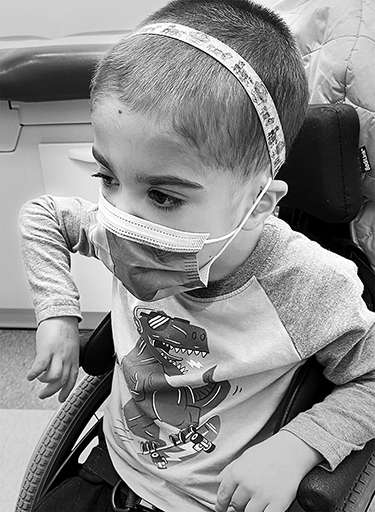
Up to this point, despite knowing I shouldn’t have, I did most of the interpreting for my son, who primarily communicates through sign language, while out in public. One summer, after a long hospital stay following a stressful surgery, I saw the way my son lit up every time one of the inpatient therapists came by and signed to him. I decided then that I needed to set my discomfort about others’ feelings and assumptions aside and advocate for my son’s right to an interpreter despite his age or ability to use the service in exactly the way others might expect.
My motivation for this decision involved so much more than his access to language in-the-moment (although that is certainly important enough on its own).
Setting an Example
A big part of my decision to start asking for an interpreter is to set an example for my son. If having an interpreter is not a big deal to me now, why would it be a big deal to him as he gets older?
As Christine Jones and colleagues describe in their 2017 article “Enablers of help-seeking for deaf and disabled children following abuse and barriers to protection: a qualitative study,” not using an interpreter when the child utilizes ASL can encourage passivity for both the family and the child. Starting at a young age, in my view, has helped our family get over the discomfort of asking for an interpreter and develop it as a habit, which has been especially helpful to us a few years later, when having an interpreter is more obviously necessary.
Making a Statement: Who is the Patient Here?
Not only does prioritizing access to an interpreter set an example for my son, but it also makes a statement to those around us. In our case, this statement has greatly impacted his interaction with medical providers. When was the first time I noticed healthcare providers talk to my son directly? It was the first time we had an ASL interpreter in the hospital room. When the doctor looked at Evan and asked what flavor of medication he would like, I realized that for years leading up to that moment, they had always asked me to choose for him. Making language access a priority helped make a statement to those around us about the importance of treating Evan as an individual with autonomy, instead of just deferring to me.
Promoting Safety and Comfort
Finally, the safety and comfort benefits of having an ASL interpreter for my young son were powerful. In the healthcare setting, having an interpreter not only promotes access, allowing him to develop a better awareness of his health, but I have also noticed that my son becomes visibly more at ease when someone other than me is in the room signing with him.
Developing a habit of utilizing an interpreter from an early age may help promote better health and safety outcomes for my son as he gets older. As authors Brittany Dale and Raschelle Neild point out in their article “The assessment needs of families with children who are deaf and hard of hearing referred for an autism spectrum disorder evaluation,” medical and developmental assessments may be inaccurate without appropriate access to language.
Helping my son, who primarily signs, develop a habit of prioritizing language access through the use of a sign language interpreter may help him receive more accurate medical care both now and in the future. ~
H&V Communicator – Fall 2025