Stepping into the Future with Higher Education
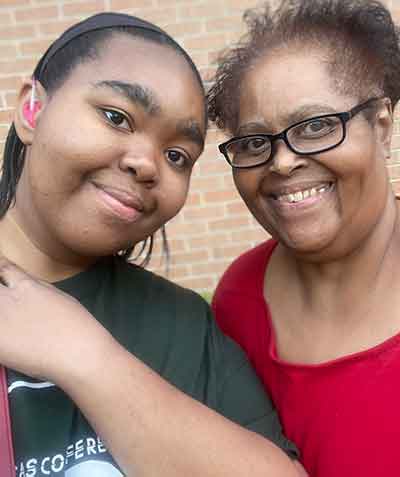
By Belinda and Bailey Kittrell, Arkansas H&V
Transitioning from high school to post-secondary can be exciting and overwhelming. Breaking down the many steps of transition into smaller tasks and dates over the high school period will relieve a lot of pressure. Your child will learn skills to use in decision preparation and planning over their lifetime. Of course, the earlier you start, the better.
Some of my child’s educational team were not familiar with her IEP. During 7th grade, we added an element into the IEP requiring that prior to the first school day, her team would have a professional development meeting with us to learn about her hearing loss, devices, best seating location, and additional accommodations. Also, no therapies could be scheduled during any required core subject course period. It worked wonders! They were more comfortable understanding her needs, and she could relax and focus on learning.
In 7th– 8th Grade: Your child should participate in their IEP meetings by providing information about their type of hearing loss and what they can/can’t hear, their devices, and what helps or does not help them understand and learn in class. What helps them learn best?
High School Selection: Does the high school offer any concurrent credit or advanced placement courses? A concurrent credit course allows high school students to earn both high school diploma credits and college credits simultaneously. Usually taught by qualified high school teachers at the high school, these courses offer college-level curriculum in a familiar setting, often at free or reduced tuition costs. Advanced Placement (AP) courses are college-level classes taken in high school, authorized by the College Board. They offer rigorous academic content, often awarding GPA weighting and college credit upon passing the standardized AP Exam in May. There are 38+ courses across seven subject categories (arts, English, history, math, sciences, languages, and capstone).Students may need to purchase the required textbooks and school supplies. Students can have the experience of working at an elevated level prior to entering college. Also, these courses can make college more affordable and provide an eye-opening view of the college workload and increasing time management.
9th – 10th Grade: Your student should be able to create a presentation for their IEP meeting on their own. This would include anticipating and answering any questions. They will need to practice and have questions posed to them prior to providing the presentation. Encourage them to practice their presentation and praise them for clarity of information and presentational style.
It is time to start looking at test preparation, taking AP, honors, and concurrent credit courses, reviewing colleges, and thinking about majors and minors. All students participate in college and career readiness in high school. Does your school have a relationship with vocational rehabilitation services for students who are deaf/hard of hearing or with additional disabilities?
Pre-employment transition services can be provided to assist a student in narrowing down interests for future career paths, training for interviews, etc. Transition assessments should be given for students through the Transition IEP, and transition goals and activities determined by the student, family, team, and community organizations, if applicable.
ASVAB: Traditionally, the Armed Services Vocational Aptitude Battery is a vocational aptitude test which requires no military commitment. It may help the student learn about aptitude in areas of career paths with which they are not yet familiar. It measures abilities in ten areas, including math, science, general knowledge, and comprehension along with mechanical comprehension. Testing is free. There are free preparation videos and sample tests available.
11th -12th Grade: Students need to focus on raising grade point averages, securing leadership roles at their schools, in extracurricular activities, or community service projects. Juniors can apply for a vast number of scholarships from academic to full-ride awards with no essay required (but apply for those if you are a strong writer!) Improve your college admission essay writing skills. Attend college fairs and learn about entrance requirements. Select the top five colleges you want to attend. What financial support are these schools offering? Here is a look at Bailey’s costs: tuition, room and board, laundry, activities, technology, athletics, experiential learning, and public safety fees.
Investigate your future job ideas. Who will you ask for letters of recommendation? Have you volunteered or have any work experience?
Primary Undergraduate Entrance Exams: The most common college entrance exams in the U.S. are the SAT and the ACT, both of which are widely accepted by four-year colleges for measuring college readiness. Both are administered by the College Board.
ACT: The ACT is a standardized college entrance exam assessing English, Math, Reading, and Science, with an optional Writing section. As of late 2025, the test is shorter (2 hours 55 minutes, excluding writing) with fewer questions, focusing on English, math, and reading for the 1–36 composite score.
SAT: The SAT is a computer-adaptive test, meaning the difficulty of the second module depends on performance in the first scoring ranges from 400–1600 (800 per section). The math section covers algebra, data analysis, and advanced math and allows for a graphing calculator.
Both tests are taken primarily by high school juniors/seniors, often for university admissions, scholarships, or as a graduation requirement.
Reminder: Extended Test Time: You can apply for extended time accommodation on both the SAT and ACT if you have a documented disability or learning difference. (A hearing difference may not be enough but document carefully in high school.) Apply early through your school to get written approval from the College Board’s Services for Students with Disabilities (SSD) or ACT Inc. Collaborate with your special education coordinator or counselor to submit documentation to outline the need for accommodations. (See What about Accommodations? page 11)
Save on fees or college tuition, and help narrow your field of study:
Accuplacer: The Accuplacer is a suite of computer-adaptive assessments used by colleges to evaluate incoming students’ skills in reading, writing, and mathematics. It determines proper placement into college-level, advanced, or developmental (remedial) courses, ensuring students are best matched to academic work. Tests include Arithmetic, Quantitative Reasoning, Algebra, Statistics, Advanced Algebra and Functions, Reading, and Writing. It is often used for students who do not have SAT or ACT scores, or for those wishing to challenge their placement. Use the free practice tools. Request a test voucher from your high school counselor.
ACT Fee Waiver: The ACT fee waiver program covers registration fees for up to four ACT tests (with or without the writing test) for eligible juniors and seniors in the U.S. Students must meet economic need criteria, e.g., on free/reduced lunch or residing in foster care. Request the waiver directly through your school counselor.
SAT Fee Waivers are also available to eligible low-income juniors/seniors in the U.S. To get an SAT fee waiver code, ask your high school counselor.
Scholarship applications: Research scholarships, grants, and work study to support your education. You can focus on leadership, academic merit, and specific talents. There are scholarships for hearing differences, too. Your counseling office can help. The ACT and SAT both have scholarships within their portals. Do your parents work for a company that offers a scholarship, or what about a church you attend? Local clubs, fraternities, and sororities can be a source of support for reaching your dreams.
Senior Year:
Challenge yourself to exceed the grade point average from 11th Grade. Attend at least two college fairs and stop at each table to see what is unique about the schools, staff, and campuses. Ask questions:
- What is the average class size for first-year students, and how accessible are professors outside of class?
- Why: You want to know whether you will have large lecture halls or smaller, personalized classes. This will assist you in asking for appropriate accommodations.
- What kind of academic support services are available (e.g., tutoring, writing centers)
- Why: Confirms you will have the necessary resources to manage the workload.
- What are the most popular internships or research opportunities for students in my major?
- Why: Highlights how the school connects academic learning to career preparation.
- What makes this campus unique compared to similar institutions?
- Why: Helps identify the school’s true identity, strengths, and “hidden” benefits.
What about costs? Saving funds on testing and college:
College Application Waiver: Students who use an ACT fee waiver are also eligible to request a waiver for college application fees using the separate request for waiver form.
Did you know that IEPs don’t follow you to college? They end at high school graduation. You will have a disability services plan in college.
Contact the Disability Service Office for Colleges: Find the disability service offices for campuses you are interested in. Discussing services with the colleges and visiting them in person can often help you decide between more than one good option.
Disability Services Office Registration: Select your college of choice. When you have an acceptance letter, request a meeting early with the Disability Services office early. It takes time to set up your meeting, evaluation, and accommodations. The process goes like this:
Submit Documentation: Provide professional proof of your disability: audiogram, formal medical report, or evaluation. While a high school IEP or 504 Plan is helpful for history, colleges often require more recent, specific diagnostic evidence.
Complete an Intake Meeting: Meet with a coordinator to discuss how your disability impacts your learning and determine “reasonable” accommodations tailored to your needs. Ask what other accommodations might be available to you. Even late-start classes and adaptive alarm clocks may be viable options. The key is that you have to identify your own needs.
Your professors will be notified: Once approved, the office will provide an “accommodation letter” to be shared with each of your instructors at the beginning of every semester to implement services. Stay in contact with disability services for implementation and changing the plan if needed. This process will repeat each new semester. (See What about Accommodations? next page)
Vocational Rehabilitation Services: This could be another way to offset college expenses and increase your success in a career. Contact your state rehabilitation services offices and ask to meet with one of their counselors about your employment and education goals. They may be able to provide support for your educational goals to help you seek employment.
Navigating this state-level agency can often help you pay for tuition, books, or hearing tech if it is tied to an Individualized Plan for Employment (IPE). You must be 18 years of age to apply; applications can often be completed online before an interview. As a needs-based system, your parents’ income is taken into account unless you are an independent student. It is a disability and not a strength-based system, so be aware of that.
We hope that this will help students prepare to step into their future. ~
Belinda Kittrell serves as an Arkansas Hands & Voices Parent Guide; Bailey, her daughter with a hearing difference, is studying Biology and ASL in college.
H&V Communicator – Summer 2026 – Digital Issue