Homeschooling as the Right Choice for Us
By Trayce Stoenescu, Texas H&V
In July of 2015, I met a Deaf person for the very first time: my newborn son, Bear. Nearly two years later, our daughter Mila came along and revealed our previously unknown genetic predisposition toward making adorable Deaf babies. I remember those first few weeks and months, as best you can in the postpartum fog, existing in a state of denial and disbelief. What followed was a healthy and necessary grieving period. I had to let go of what I thought motherhood would look like for me, and I had to acknowledge that I wasn’t fluent in the language most accessible to my own children from birth. My mind was flooded with questions. Would I ever read them a bedtime story? Would they love music like I do? What about their safety and environmental awareness? Somehow, although my motherhood journey had just begun, I already felt so far behind.
The truth is, the first years of parenting kids with disabilities can often feel disempowering. Without warning, I was thrust into endless medical appointments and asked to make decisions I didn’t feel ready to make. I envied other new parents who never had to think about what language their two-month-old would use when she asks to go to prom in eighteen years (a real conversation I had with an audiologist). It seemed that specialists, doctors, therapists—really anyone else—had all the answers, and I had none.
For several years, we enrolled our kids at Texas School for the Deaf, prayed for guidance, consumed every free resource available, took sign language classes, attended countless webinars and retreats, and met with medical specialists and Deaf adults from every walk of life. Through that process we realized there are many “right” ways to raise and educate a D/HH child. This truth empowered us to make the choices that worked for our family, and in 2020, we took the homeschooling plunge.
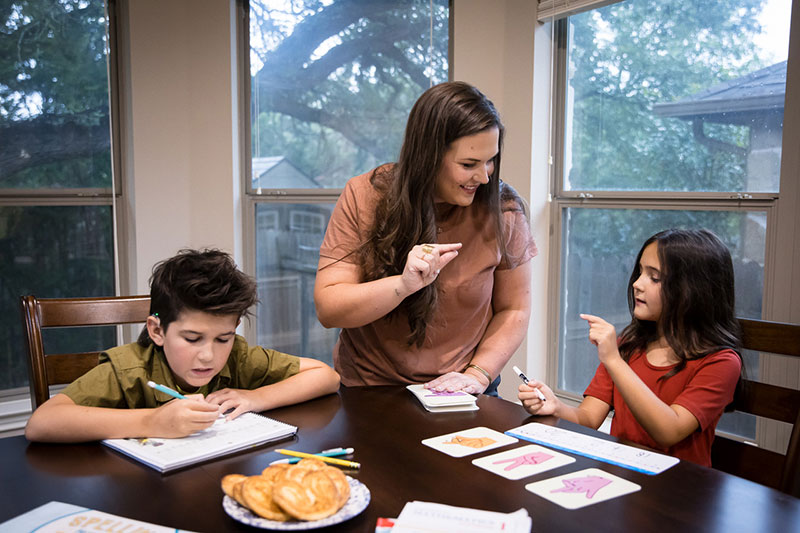
As all home educators do, we’ve had to think outside the box to find what works best for Bear and Mila. I began to see with my own eyes how vibrant home education could become when I embraced the unique needs of my Deaf children. For us, this has looked like a patchwork of traditional methods, curricula, and resources. We have pivoted more times than I can count. Some of our favorite supplemental tools are ASL storytelling videos from Rocky Mountain Deaf School, visual manipulatives, D/HH mentor programs, and an ASL/English bilingual online dictionary.
In the last five years, we’ve learned a lot about what works and what doesn’t work for us, and these three findings in particular have proven to be invaluable in our homeschool journey. They shape our day-to-day, and give me renewed confidence in our decision to homeschool.
For D/HH kids who use hearing technology, listening fatigue is so real!
A recent study by Vanderbilt University concluded that children who are D/HH often have to commit more cognitive resources to listen and access information than their hearing peers. You might find it beneficial to limit background noise at home during school hours. For many D/HH children, it is difficult to localize and distinguish spoken language even in the most perfect listening environment. Music, television, and little siblings make this even more difficult. Oftentimes, my son will remove his tech completely so he can focus on a task.
Find opportunities to expose your children to their D/HH peers.
This has been a huge focus for me in the last few years as my children get older and become more self-aware. It’s important to me that they recognize they are part of a larger culture of D/HH people and they’re not alone. To achieve this, we regularly attend ASL classes in our area, organize meetups with D/HH friends, attend D/HH events, and incorporate books that feature D/HH characters into our homeschool rhythm. You might want to connect with your local library. Libraries typically have a wealth of knowledge about community events and classes.
Parent involvement is the most important factor in the success of a D/HH child.
You, fellow homeschooling parent, are irreplaceable in the education of your D/HH child. No one knows them like you do. You are the expert on your child, their most passionate advocate, and you are equipped for this work! It is hard, but you are not alone. I see you and I’m with you. The term “hearing loss” doesn’t really fit my children at all. How could they lose something they never had in the first place? The truth is, hearing loss has only ever added to our lives and my children are a blessing to our family just the way they are. When I embraced my children’s deafness, I gained a vibrant community, bilingualism, new friends, and a fiery passion for advocacy. When we lean into their giftings, celebrate their differences, and champion the way D/HH children learn best, we all win. ~
Editor’s note: Stoenescu is a homeschooling mom in central Texas area where she lives with her husband and her two Deaf children, born with Connexin 26. She is passionate about early intervention, language access, and advocacy, and for parents to be given the resources and tools they need for the joyful journey of raising D/HH children. Trayce also works as a Parent Guide for Texas Hands & Voices. This article was slightly adapted from a previously published piece in Wild + Free magazine. Find her on Instagram @trayce_stoenescu.