Meaningful Family Engagement
A Short Guide for Professionals
By Janet DesGeorges, H&V Headquarters, FL3 Center
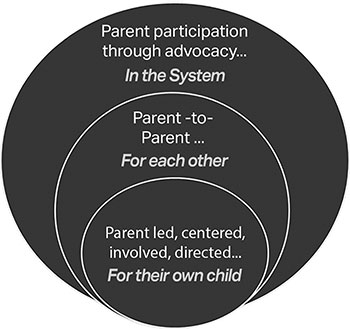
There is widespread consensus that family involvement significantly influences the developmental outcomes of children who are Deaf or Hard of Hearing (D/HH). Whether it is through the lens of a parent’s involvement in their own child’s communication and language growth in the early years, or about family engagement in the systems that serve us—including Early Hearing Detection and Intervention (EHDI) programs, education years, and community life—parental engagement is a cornerstone for success. “For your own child, for other parents, and for the systems that serve us” is a concept that Hands & Voices often refers to in the work of parent involvement. While the strategies and skills needed within these three areas are unique, many families who are successfully supported to be empowered for their own child go on to support other families and also represent families in systems work. Regardless of the lens in which these things are examined, it can be productive to look at the criteria for success in these areas as a continuum of growth for a parent in developing their parenting and leadership skills. The strategies are useful for engaging individual parent involvement and family-based organizations (FBO’s) as well.
In order to effectively implement parent involvement, a position paper of the Parent Empowerment Committee of the Federal Interagency Coordinating Council (Sept. 2000) was created to enhance the understanding of what meaningful parent participation embodies. The following list is adapted from this document and expanded upon from the work that the H&V Family Leadership in Language and Learning Center (FL3) has found to be effective in engaging families and family-based organizations (FBOs).
Family Engagement in the System: What professionals can do to support this
To truly empower families and cultivate effective partnerships within systems serving children who are D/HH, it is crucial to embrace specific strategies. The following guidelines outline how professionals can build a robust support ecosystem where families are not just recipients, but active, informed partners and leaders.
Provide family-identified supports to assist the family’s participation:
- Provide convenient meeting times and locations for family members, including virtual attendance opportunities.
- Compensate families for their time, expertise, and expenses, recognizing that many parents give unpaid labor, which can exclude those who can’t volunteer.
- Provide and/or compensate for childcare, transportation assistance, virtual attendance, and flexible scheduling.
- Demonstrate how Federal programs support families to attend national conferences.
- Clearly identify a staff/agency person to be the primary contact person for reimbursement and other issues. Be sure she/he understands that timely reimbursement is essential.
- Develop provisions to ensure that parents are present to participate in policy-related activities, including participation in the development of their own scope of work.
- Identify these supports in RFP’s (request for proposals), grants, and policy.
- Provide complete, appropriate information prior to meetings in a timely manner.
- Match veteran parents with inexperienced family members to ensure that new members feel supported in their roles as advisors and have the opportunity to share their ideas.
- Consider incorporating a “family leave” policy so family members can choose an inactive role but maintain their membership should family circumstances require some time off.
- Recognize that some family members may require more and distinct kinds of support than others to participate in a meaningful way.
- Encourage and facilitate family-to-family support and networking.
- Consider contracting with a family-based organization rather than an individual to ensure diversity, training, peer infrastructure and sustainability.
Provide formal orientation and preparation for families and provide information for involving them:
- Provide orientation to both family members and staff about the issues, participants, and process.
- Provide informational support for parents to be prepared to participate as equal partners on a “level playing field” with their professional counterparts.
- Ensure there are clear role expectations.Many parents step into leadership without a clear understanding of decision-making power, time commitment, or deliverables.
- Provide skill-building training pathways in advocacy, facilitation, public speaking, conflict resolution, and cultural competence. (see resources at the end of this article).
- Provide technical assistance, leadership mentoring, training, and other parent leadership teaming. Pairing new leaders with experienced ones can build confidence and skills before taking on major roles.
- Ensuring ‘Systems Literacy’ through training parents to navigate EHDI programs, IDEA/IEP processes, medical systems, and funding streams.
- Understanding of language and communication options: Ensuring leaders can speak knowledgeably about all options without bias.
- Ensure parents are trained to also represent families that are different from their own stories and decisions.
- Building awareness of intersectional needs: Understanding DHH Plus (additional disabilities), late-identified children, and cultural considerations.
Ensure diversity among family members:
- Honor the racial, ethnic, cultural, and socioeconomic diversity of families.
- Develop a plan for identifying a diverse, representative group of families to participate in the implementation of the system/programs serving families.
- Provide all materials in the families’ preferred language.
- Recruit broadly from the community and the population the program serves.
- Bring in new families alongside seasoned parent leaders to ensure a natural succession plan over time.
- Adapt collaborative models to diverse cultures. Manage the changing distribution of power and responsibility. Incorporate principles of collaboration into professional education.
- Be particularly careful to include members of traditionally underserved groups.
- Avoid any appearance of tokenism.
- Intentional outreach to underrepresented groups (racial/ethnic minorities, rural families, low-income households, DHH parents themselves, parents of children with additional disabilities).
- Ensure access through full ASL interpretation, Cued Speech transliterating, captioning, and materials in plain language or multiple languages.
- Involve in decision-making – Ensuring parent voices are not tokenized but have influence at the policy and program level.
Be ready to hear what families say:
- Encourage and support family members to find their voice.
- Create safe spaces for diverse opinions – Encouraging constructive disagreement and valuing lived experience equally with professional expertise.
- Ensure that parent perspectives are not a separate component of the policymaking process but instead are infused throughout.
- Always consider an individual parent’s story as being valid.
- Respect the passion families have for change.
Celebrate the partnerships of working together for change:
- Support staff in developing an understanding of the value of family participation.
- During and after meetings, specifically recognize the value of the family’s participation.
- Provide clear information about the goals of the board, task force, or committee, and the role of individual members and the roles of family members
- Balance membership on committees between families and professionals.
- Consider shared leadership – parent and professional co-chairs or teaming.
Leadership sustainability:
- Avoid burnout through strategies such as rotating roles, clear term limits, and distributing work to avoid over-reliance on a few individuals.
- Provide continuous professional development – opportunities for parent leaders to keep learning (conferences, webinars, certifications).
- Create leadership pipelines that have a plan to recruit, train, and transition new leaders into roles before vacancies occur.
- Ensure partnerships with family-based organizations (FBOs) – Many FBOs have succession planning for their leadership and can be utilized for parent representation over the long term.
Measure impact:
- Tracking leadership outcomes using data to measure how parent leadership changes programs, policies, and family outcomes.
- Use evidence-based measures that track family involvement. In a study by Moeller (2000), family involvement was measured by advocacy for the child, attendance and participation in education services, extended family support, ability to pursue information on their own, effective and independent language models and evidence of positive family adjustment.
- Celebrate Achievements, officially recognizing the contributions of parent leaders to maintain motivation and visibility.
These strategies illustrate that effective family engagement is multifaceted, operating on a continuum from empowering individual families in their child’s development to cultivating systems-level family leadership. Meaningful family involvement, driven by these strategies shared, form the bedrock for successful outcomes for meaningful parent leadership and engagement. Families will not just be recipients of services, but active, informed partners and leaders who drive positive change for their own children, for other families, and for the systems designed to serve families of children who are Deaf/hard of hearing. ~
H&V Communicator – Fall 2025