Keys for Discussing Genetic Testing with Families:
A Guide for Professionals
By Sara Kennedy, H&V Headquarters
A new addition for professionals has been added to the Hands & Voices resource page on genetic testing. Together with our group of family leaders who also worked on the parents’ guide (published October 2025 on the website) including parents of deaf/hard of hearing children from three countries, deaf/hard of hearing parents and professionals, and the assistance of a genetic counselor who graciously reviewed the document, we developed a guide for those professionals who support families in considering or receiving genetic testing. Inside, the complexity of this decision for families and the value placed on informed consent while sharing common questions that parents may have is highlighted.
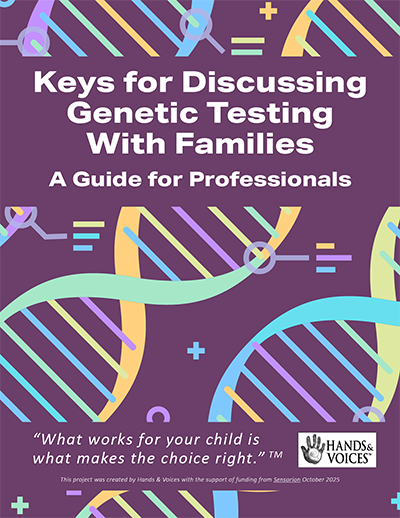
Readers will first find the introduction and the “why” of this resource. Further sections elaborate on aspects as diverse as “should genetic testing be a choice?” and discussing the impact of results, whatever those may be, along with recognizing Deaf culture, faith-based concerns, other cultural considerations, and privacy and ethics. Considerations for families with children who are deaf/hard of hearing “plus” are also featured.
In an effort to include “just-in-time” learning, we included an executive summary and a chart with “Say This, Not That” to give examples of language that families can find empowering and collaborative, with helpful phrasing that respects family autonomy and perhaps a time of conflicting emotions. Professionals can look up additional resources for independent learning and even find genetic counselors working remotely, along with other suggested resources for the families they serve. The guide also includes a section on recognizing inequities in referral patterns, geographic access, and other systemic barriers. We were thrilled to include forwards by Dr. Dylan K. Chan (University of California, San Francisco) and Dr. Elliot Shearer, at Boston Children’s Hospital/Harvard Medical School after they reviewed the document.
The field of genetic testing and potential treatment is accelerating quickly. Genetic treatments for OTOF (otoferlin, causing a rare form of auditory neuropathy spectrum disorder, or ANSD) are expected to move close to regulatory approval in the next year or so. Studies are occurring for GJB2 genetic differences (which makes the connexin 26 protein) one of the most common genetic causes of congenital deafness (present at birth). Usher’s syndrome studies are also underway. With this research underway, we hope this professional guide centers those who work with families in the kind of inclusive, collaborative care we all hope to receive. In particular, the guide emphasizes the importance of including a referral to genetic counseling, something families routinely report as immensely helpful in understanding their choices, processes, and potential or actual results, and a referral to family-to-family support, something families routinely rate as “most helpful” in their parenting journey.
Visit the new website page to peruse the professional guide and other resources, such as:
- A Parent’s Guide to Exploring Genetic Testing: Making Informed Family Decisions
- Questions to ask your Genetics Counselor
- An Infographic about Genetic Testing Considerations
- PowerPoint Presentation from the 2025 National EHDI Conference, titled The Genesis of Resources Development and Partnerships: Genetic Testing Information for Families
Find these on the Hands & Voices website under Resources>Genetics at https://handsandvoices.org/resources/genetic-testing/index.html
We invite you to explore these documents. We welcome feedback about your own journey and/or wished-for further information. If you have a personal story about genetics and would like to be included in an upcoming article, contact us at editor@handsandvoices.org ~
H&V Communicator – Spring 2026