One Family’s Journey
Our Experience with a Gene Therapy Clinical Trial
By Sierra Smith, New York H&V
What do you do when you give birth to a deaf newborn when you’ve never even met a deaf person in your life?
He had a complicated early birth. My son was born at Halloween instead of his Christmas due-date. He had to spend time in the NICU before he was ready to come home. His hearing screening was delayed. I was told he didn’t pass the screening, and to follow up with audiology. My first audiology visits were confusing. They didn’t specialize in pediatrics per se and the Auditory Neuropathy Synchrony Disorder (ANSD) diagnosis they gave him came with a big question mark. The audiologists had said that he wasn’t a candidate for hearing aids or cochlear implants… that he would just experience noise with his type of hearing loss.
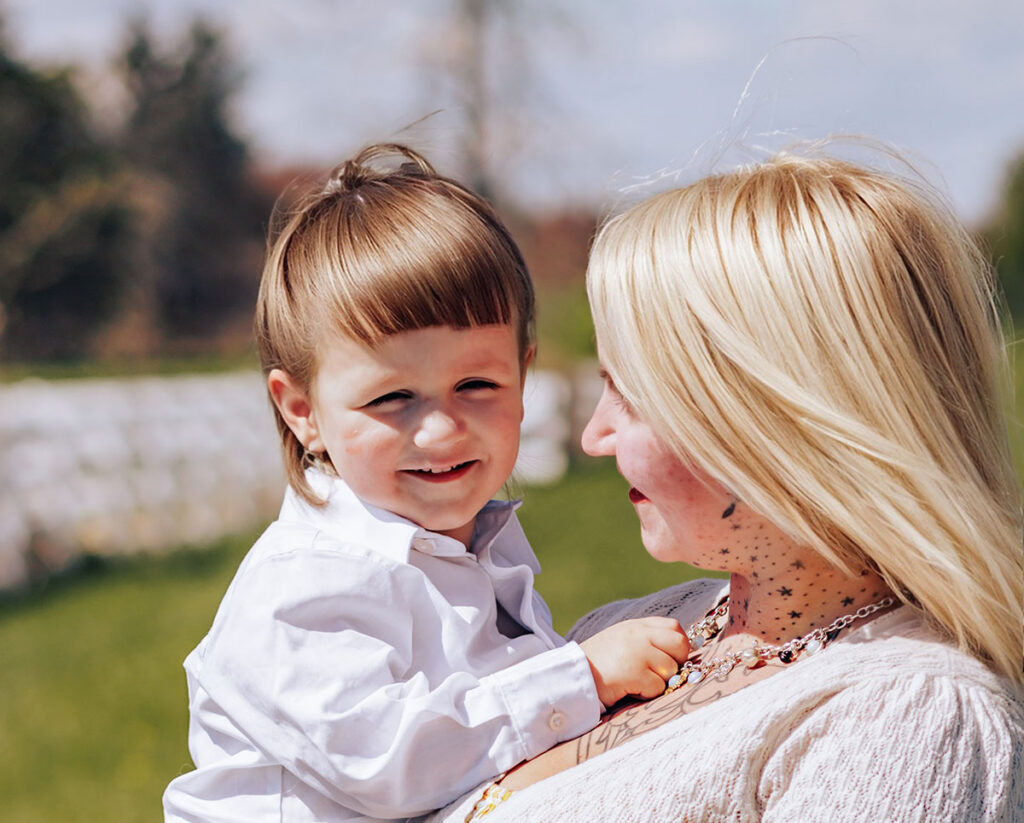
The amount of stress and overwhelming guilt that he was born deaf washed over me like a tsunami. I felt it was my fault. It motivated me to research and become a great mom and advocate for my son, Travis. I was all he had; my partner left us when he learned our son was deaf.
I quickly got in touch with Early Intervention and the New York Hands & Voices community. I wanted to learn everything I could to help him develop, and to have my son to be around children like himself. We started learning sign language. We entered speech therapy as soon as we could.
But months into this, he wasn’t making progress. All the other children I met could still communicate (in sign and/or spoken language) to some extent and used hearing aids or cochlear implants not available to Travis. Where was the road to success with him? I searched everywhere for answers. At a year old, he still wasn’t responding to sign despite all our efforts in early intervention. Sounds meant nothing. He couldn’t tell me what he wanted – instead he would pull me towards cereal or toys. Picture systems weren’t working either. Something was missing in our connection to each other.
I came across an article about a little girl named Opal in England who had gene therapy in a clinical trial. She went from deaf to having near-normal hearing in her treated ear with gene therapy. And her new hearing was holding steady. I couldn’t help but wonder if my son also had this specific genetic mutation (I know now the term of choice is “variation” or “difference”.) I asked my son’s audiologist about it. She told me there was a rare 1% to 2% chance that his deafness was genetic and related to OTOF, the gene related to the clinical trial. She believed his hearing loss was most likely caused by prematurity and jaundice.
I had to know. Given his difficulty learning language, I decided to speak up and advocate for my son. I was completely new to this world, so that took some courage. I told her I was interested in doing genetic testing anyway even if the chance was slim. I just needed to rule it out.
To the surprise of both of us, he had the OTOF gene difference, which made him a candidate for the gene therapy trial I had read about. I was never so excited to see the words “positive for this genetic mutation!” After what felt like hundreds of DNA tests, blood tests, cheek and urine swabs and samples, we finally got approved for the step to introduce the gene therapy medication into his ears. I signed paper after paper showing I understood the risks of surgery and know that a positive outcome is not guaranteed. I had so much faith in the Regeneron team doing the FDA-approved study, and Dr. Lustig at Columbia Medical Center in New York City. I trusted him with my entire being. He had only done this specific surgery two times before but had done many cochlear implants. My son would be the third child in New York to have the procedure. It was truly nerve-wracking. Surgery went perfectly, though, and the waiting began.
Will his hearing improve?
At first, nothing happened, Then, about 2 1/2 months after surgery, my son began to startle to noises during his sleep. Next, he would wake up to my voice in the morning. This was new! He began to enjoy cartoons. He’s showing more interest in music, playing the guitar and the piano than ever before. The Otarmini medication had begun to work. His speech therapy time has been increased with this progress.
I once cried in the bathroom of a H&V event because I felt like my son was still isolated from the other children. He was so different. (I know that I couldn’t know what all the children were going through, but that’s how it looked to me.) Now, over a year from surgery, my son is hearing at a mild-moderate level in his right ear, and moderate-severe in his left. His ears are expected to become more equal. He was finally fit with hearing aids. He likes them and kept them in all day from the start. I am anxiously awaiting those first words, but he is already understanding more and responding more. He is happier, He seemed to be aggravated with only sign language. He just wasn’t gravitating towards sign despite 20 months of trying (and I am still trying all the things.)
I am finally looking forward with hope. I was so honored to share our story for any other parents who might be looking for help. Working with Regeneron has been an absolutely wonderful experience. It’s a plus to share all these interviews, to visit the Oval Office, and share about auditory neuropathy and gene therapy, but that pales in comparison to the hope I feel now. We will continue to go for hearing tests regularly over the next ten years to monitor the improvement. I am told improvement will slow down and then stop, and while younger children did better, this is a win for us.
Because gene therapy enabled him to benefit from hearing aids, I know one day he’ll be able to hear his name called when he walks across the stage for graduation, he’ll get to hear his wife’s vows on his wedding day, and when he’s older, I’ll be able to share more of this story with him and let him know how proud I am of him. He has been so brave. For now, he is undergoing more evaluations before he starts preschool this fall. That may unwrap another piece to the puzzle.
For any parent of a deaf or hard of hearing child, I truly believe they should be offered genetic testing. I was not offered genetic testing until I asked. There are other conditions like this where a parent can learn so much about what might work for a child’s future, and in the case of OTOF-related hearing loss, there is much that can be done. Every family deserves access to information that allows them to understand and consider their options.
Editor’s note: About OTOF and Gene Therapy
OTOF-related auditory neuropathy is a rare genetic form of hearing difference. In 2024, the FDA approved Otarmini from Regeneron for children with hearing loss caused by variants in the OTOF gene after years of testing in animal studies. Long-term outcomes continue to be studied. Genetic testing may provide families with information about the cause of a child’s hearing difference (if it is genetic in origin), and whether or not hearing may progress (get worse), other medical considerations, research opportunities, and, in some cases, efficacy of hearing aids or cochlear implants use. For more information about Genetic Testing, find resources here: https://handsandvoices.org/resources/genetic-testing/index.html ~
H&V Communicator – Fall 2026