White Noise Apps for Babies with Hearing Loss — What Parents Should Know
By Janet DesGeorges, H&V Headquarters
Raising children in this day and age has many wonderful advances that didn’t exist when I was raising my young children. And yet, parents of children who are DHH might need a bit more reflection and thought to ensure that our children are benefiting from today’s technology safely. Hands & Voices has a presentation we have done over the years called, “Is This a Deaf Thing?” I was reminded of that presentation as I sat in a meeting recently with scientists and researchers from all over the world who focus on DHH children.
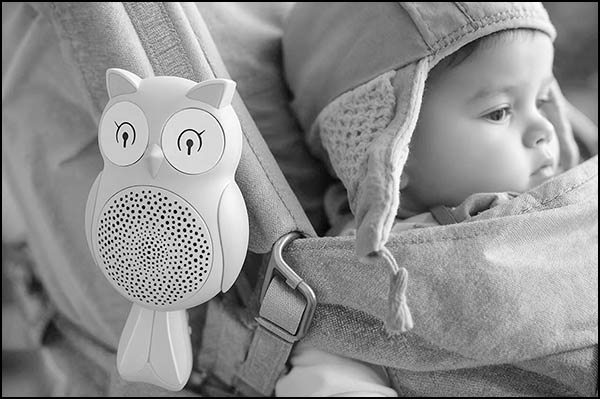
A topic came up that I had never even considered before: using white noise apps or machines for babies. Are there special considerations we should think of for children who are DHH? While white noise apps and machines can be a helpful tool, it’s important to balance the benefits with safety. White noise apps should be used responsibly, with guidance based on recent research and expert recommendations. For children who already have sensorineural hearing loss, safe sound exposure becomes even more important. While white noise can still be used, families should take additional steps to ensure it does not interfere with hearing access, speech and language development, or the functioning of hearing technology.
This article looks at some considerations that parents of children who are DHH should explore.
Why white noise is used
Many parents use white noise because it can help babies sleep better. White noise may replicate the ambient (i.e., surrounding, environmental) sounds babies are used to hearing in the womb (heartbeat, muffled noises, etc.), and can mask sudden household noises such as siblings playing, dogs barking, traffic, etc. that otherwise might wake them. For some infants, that constant low-level hum can help them fall asleep faster and stay asleep longer. White noise can be a beneficial “sleep tool,” especially when household noise, siblings, pets, or other disruptions make it hard for a baby to nap or sleep. But using it safely means paying attention to volume, distance, and duration.
What the research says about risks
White noise isn’t intrinsically harmful. The danger comes when the sound is too loud, too close, or on for too long.
- A study measuring multiple infant sleep machines and baby-sound apps found that at maximum volume with the device placed very near (about 10 cm) to the “infant ear,” 9 out of 14 devices exceeded 85 dBA — a level associated with risk for noise-induced hearing loss (NIHL) in adults.
- When such loud sounds are maintained for prolonged periods (for example, throughout an entire night), cochlear hair cells and other delicate structures in the ear can suffer mechanical and inflammatory damage — damage that may be irreversible.
- In a safety review, the American Academy of Pediatrics (AAP) and hearing-health experts concluded that some “infant sleep machines” (ISMs) produce noise levels well above safe limits for infants, and that consistent overexposure is a concern. Thus, especially when used improperly — white noise machines and apps do carry a risk of hearing damage or impaired auditory development.
What “safe” white noise use looks like
Based on research and expert guidance, parents should follow these principles if they choose to use white noise:
- Keep volume low. Aim for 50–60 dB SPL (A-weighted) — roughly the volume of a quiet shower or soft conversation.
- Keep noise source far from baby’s ears. Place the device as far from the crib as possible — at least 7 feet (≈ 2 meters) away is recommended by AAP-based guidance.
- Limit the duration. Use the white noise mainly to help baby fall asleep or settle, then consider turning it off — you don’t necessarily need it running all night once baby is asleep.
- Use the lowest effective setting. Many machines/apps default to higher volumes — adjusting down is often safer and still effective.
- Some clinical guidance goes further to suggest designating white noise as a sleep-only tool (not constant background sound), and to avoid placing devices inside or very near the baby’s crib.
What to watch out for
- If the white noise is louder than a soft shower (i.e., sounds like a vacuum, traffic, or garbage disposal), that’s a red flag — such levels over time may be harmful.
- If the device is close to the crib or baby’s head (on the crib rail, in a bassinet, right beside their head), that greatly increases risk.
- If the sound runs all night long at high volume — especially without a timer — that’s a potential problem.
- Over time, even moderate but sustained exposure could impact hearing, auditory development, or sleep quality.
Special considerations for children who already have sensorineural hearing loss (SNHL)
- Avoid masking speech and environmental sounds your child needs to hear
- Children with SNHL rely heavily on clear access to speech for learning, bonding, and language development. White noise — even at safe levels — can mask or “cover up” the speech frequencies that children with hearing loss need to hear throughout the day. The American Speech-Language-Hearing Association notes that background noise can significantly affect speech perception for children with hearing loss, even when using hearing aids or cochlear implants. (ASHA, Effects of Noise on Speech Perception). This is especially true during waking hours when children are developing listening and spoken language skills. Tip: Keep white noise limited to sleep times only, not during active play or learning.
- Check interactions with hearing aids or cochlear implants
- Hearing devices can amplify the white noise signal, sometimes making it louder than intended. Some devices may also respond differently to constant broadband noise. Pediatric audiologists caution that steady noise sources can reduce the signal-to-noise ratio (SNR), making it harder for children with hearing loss to detect important sounds. (Pediatric Audiology Textbook, Thieme) Tip: Consult your child’s audiologist about recommended safe decibel levels and placement of the sound machine when hearing devices are worn or turn hearing technology off during sleep if preferred.
- Be especially mindful of volume, distance, and duration
- Because children with sensorineural hearing loss (SNHL) might be more vulnerable to additional noise-induced damage, keeping exposure well within safe limits is essential. The AAP notes that infants and children can still acquire noise-induced hearing loss on top of an existing hearing loss if exposed to high-intensity sound for prolonged periods. Tip: Maintain volumes at 50 dB or lower and keep the machine as far across the room as possible.
- Ensure white noise does not interfere with auditory development goals
- For children working on auditory skills, consistent access to meaningful sound is critical. Non-essential noise, even if calming, should not dominate sound environments outside of sleep. Early childhood hearing experts emphasize that optimal auditory access helps drive brain development related to listening and spoken language. (Joint Committee on Infant Hearing, 2019 Position Statement) Tip: Preserve quiet listening environments during the day where your child can hear speech, music, environmental sounds, and your voice clearly.
- Talk with your child’s audiologist about individualized guidance
- Each child with SNHL is different. Audiologists can measure these sound inputs: actual decibel levels in the nursery; how the white noise interacts with your child’s devices; whether nighttime sound might affect auditory access or comfort. Tip: Bring your white-noise machine or app to the next audiology appointment so the audiologist can assess it directly.
White noise–when used thoughtfully–can help your baby sleep better. But “helpful sleep aid” and “risk-free” are not the same thing. Because babies’ ears are still developing, prolonged exposure to loud noise (or noise played too close) can pose a risk of hearing damage and could impact auditory development or future speech/language skills. If you use a white noise machine or app: treat it like a tool, not a toy. Keep it low, keep it far, and don’t leave it running for hours on end. That way, you get the benefit of better sleep — without compromising your baby’s hearing.
For more information for your informed decision-making, check out these sources:
The Pros and Cons of Using White Noise to Put Babies to Sleep
https://www.healthline.com/health/parenting/white-noise-for-babies
Preventing Excessive Noise Exposure in Infants, Children, and Adolescents
https://publications.aap.org/pediatrics/article/152/5/e2023063753/194472/Preventing-Excessive-Noise-Exposure-in-Infants
Hazardous sound outputs of white noise devices intended for infants
https://www.sciencedirect.com/science/article/abs/pii/S0165587621001506
How Loud should white noise be?
https://www.bettersleep.com/sleep-science/how-loud-should-white-noise-be-for-baby
Are white noise machines bad? Here’s what the latest science says.
https://www.washingtonpost.com/wellness/2024/06/24/white-noise-machine-safe
H&V Communicator – Winter 2025